 Solar power and climate change
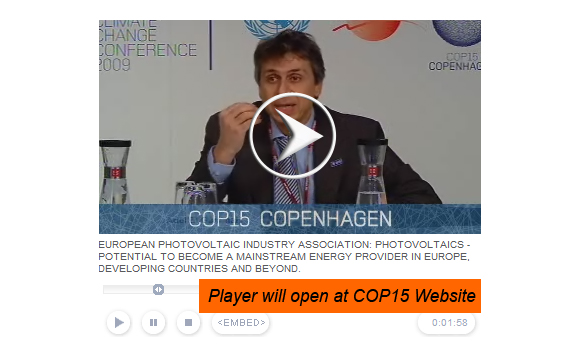
Speaking earlier today at a press conference in Copenhagen, the head of the main European photovoltaic (PV) industry organization made the case for PV as a fundamental solution to climate change.
“The problem is global,” said Adel El Gammal, “and PV can bring a global solution.”
El Gammal, secretary general of the European Photovoltaic Industry Association (EPIA) since 2008, pointed to PV’s major pluses. His key points included:
- Solar energy is massively available.
- PV can provide distributed electrical generation (as well as centralized).
- It’s a scalable technology, from a few watts to MWs.
- PV can ramp up production very quickly
- It is one of the only technologies that be easily integrated into a dense urban setting.
The potential for solar energy is not just theoretical, he added. In the last year alone, El Gammal said, PV accounted for nearly 20% of all new electrical generation in Europe — some 4.7 GW.
Solar in the “Sunbelt Countries”
 In the developing world, El Gammal sees an even larger role for solar PV.
The land between 35°N latitude and 35°S is sometimes referred to as the Sunbelt Countries, for reasons that are obvious after glancing at the map to the right, showing the amount of solar energy falling on the planet.
“Sunbelt countries contain 75% of the world’s population,” said El Gammal, “and are also the fastest growing populations.”
Many of the sunbelt countries have a poor electrical infrastructure — with many as 1.6 billion people living with access to electricity. And where electricity is available it is generated primarily by fossil fuels and at a higher cost than elsewhere.
“PV is a perfect solution to match increasing electrical demand” in sunbelt countries, said El Gammal. It is already competitive with peak load generation and, he added, in two to three years, PV will be competitive with medium load generation.
These projections come from several studies commissioned by the EPIA, primarily the report SET for 2020, published in June of this year. That study takes its name, and its mission from the European Union’s climate and energy policies goals adopted in 2007. These include the so-called 20/20/20 goals:
- Reduce greenhouse-gas emissions unilaterally by 20% from 1990 levels;
- Ensure that renewable energy represents a 20% share of total energy use;
- Reduce overall energy consumption by 20%.
By combining a number of best-case scenarios, the EPIA claims that PV can provide more than half of the EU target for renewable energy, moving from 1% of all electrical generation today to up to 12% by 2020.
A Needed Vision
But is such a rapid shift really possible, or is this just a case of industrial wishful thinking? I put that question to Mark Z. Jacobson, a professor of civil and environmental engineering at Stanford University, and director of the Atmosphere/Energy Program at the school.
Although Jacobson couldn’t speak to the details of SET for 2020 plan, he told The Phoenix Sun that the report is “the kind of vision needed to solve serious problems we are all facing with respect to climate, air pollution health, and energy security.”
Like El Gammal (who told a reporter today that “We have to change our relationship with energy”), Jacobson does not think half-measures are adequate. “I think we need to transform our energy infrastructure entirely,” he said, “to a combination of large scale renewables, including PV, and this needs to occur over the period of 20-40 years (2030-2050)….PV will play a pivotal role in this transition, so large-scale plans such as this are welcome.”
(Jacobson is no stranger to large-scale plans. He is co-author, with Mark Delucchi, of the recent Scientific American cover story, A Plan to Power 100 Percent of the Planet with Renewables).
Which Energy Future?
El Gammal ended by pointing out what so many seem to miss: that our energy choice has very little to do with technology per se. It’s a question of policy.
“There is no technological issue with PV,” he said. “It is just a matter of political will.”
Which is both bad news and good
Bad, because politics are far more complicated than any technology. Good, because politicians are the servants of public will. That means the choice is ours, as is the responsibility for conveying our determined wishes to our leaders.
Resources
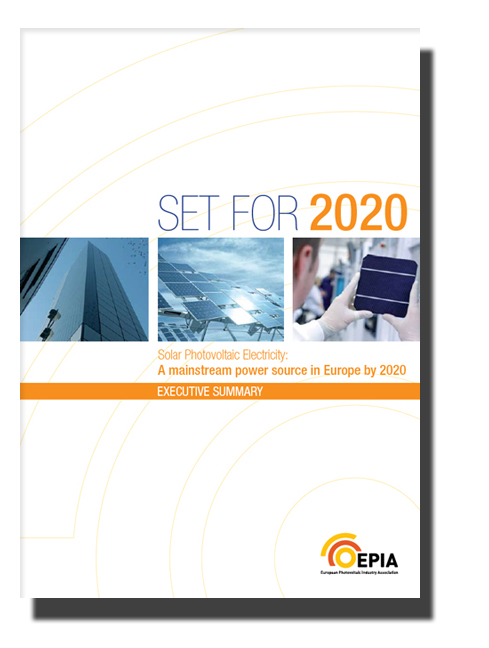 To download the executive summary of the SET FOR 2020 report, click on the report image. (PDF file.)
.
.
.
.
.
.
.
.
.
.
.
.
.
.
.